Marketing on global marketplaces: how to stand out on Amazon, Mercado Libre and Walmart in the age of AI
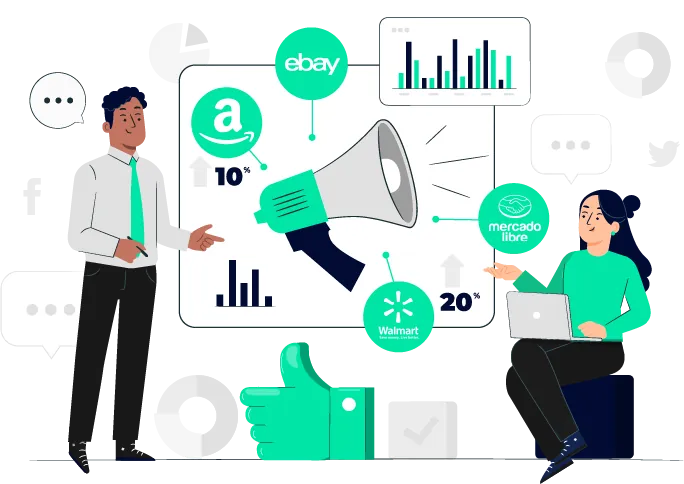
Amazon, Mercado Libre, Walmart and Falabella bring together hundreds of millions of shoppers, and for that very reason they also attract millions of sellers competing for the same search. A good product is no longer enough: you need the algorithm to show it, the shopper to choose it, and your ad spend to pay off. In this article, we explain how marketplace marketing works today and what changed with the arrival of artificial intelligence.
Why is marketing key to selling on marketplaces?
On a marketplace, customers compare in seconds. They see dozens of similar products, at similar prices, on the same screen. What decides who makes the sale is visibility (showing up in the top positions) and conversion (a listing that persuades). Both depend on marketing:
- Organic visibility: search algorithms reward products that sell, convert and have good reviews. Without an initial push, a new product will have a hard time breaking into that cycle.
- Paid visibility: ads inside the marketplace are now the most direct way to get in front of a shopper with purchase intent.
- Conversion: titles, images, videos and brand content are what turn a visit into a sale.
Retail media: advertising inside the marketplace
Every major marketplace now has its own advertising platform, known as retail media: Amazon Ads, Mercado Ads on Mercado Libre, Walmart Connect and Falabella's advertising solutions, among others. Their advantage over traditional advertising is that they reach shoppers at the exact moment they are looking for something to buy, using real purchase data for targeting.
The most widely used formats are:
- Sponsored Products: ads for individual products in search results. They are the foundation of any strategy.
- Sponsored Brands and Display: brand ads featuring a logo and several products, or banners that follow shoppers on and off the marketplace.
- DSP (Demand-Side Platform): programmatic audience buying for reach and remarketing campaigns at a larger scale.
The metrics that matter are ACOS (ad spend as a share of ad-attributed sales) and TACOS (ad spend as a share of total sales). A TACOS that declines over time is a sign that advertising is building organic sales, not just buying them.
The new storefront: AI shopping assistants
The biggest change in recent years is how shoppers search. Amazon has integrated Rufus, its AI shopping assistant, and more and more people ask ChatGPT, Perplexity or Google which product to buy before they even visit the marketplace. They no longer just type "organic honey," but "which organic honey makes a good gift and ships fast?"
This changes how a listing is written. Beyond keywords, the content has to answer questions:
- Explicit benefits and use cases: who the product is for, when it is used and what problem it solves.
- Complete attributes: materials, dimensions, certifications, origin. AI assistants read the catalog's structured fields, not just the title.
- Plenty of genuine reviews: assistants summarize what buyers say. Programs like Amazon Vine help generate the first reviews for a new product.
- Brand content: A+ Content, videos and a brand store reinforce trust and conversion.
From manual optimization to AI-managed campaigns
An account with hundreds of products across several marketplaces and countries generates thousands of decisions every day: raising or lowering bids, pausing keywords that don't convert, adjusting prices against competitors, restocking before a campaign runs out of inventory. Doing it manually is slow and expensive.
Today, AI agents can carry out that work continuously: they analyze the performance of every keyword, adjust budgets based on profitability, detect competitor moves and send alerts when something falls outside expectations. The human team's role shifts to strategy: which markets to prioritize, which products to push and how to position the brand.
Beyond the marketplace: external traffic
The fastest-growing brands combine on-marketplace advertising with external traffic: social media, content creators, Google and email. Amazon, for example, offers tools like Amazon Attribution to measure that traffic, along with programs that reward brands for driving it. On top of that, sales that come from outside also improve organic ranking.
How we do it at LAP Global
At LAP Global, we run our clients' marketing on Amazon, Mercado Libre, Walmart, Falabella and other marketplaces by combining AI agents that work 24/7 on campaigns, pricing and inventory with Key Account Managers who know each market. Everything is visible in a centralized dashboard with real-time metrics.
If you are a Latin American brand looking to grow in North America, or a US brand looking to reach Latin America, check out our 1P and 3P models or read our guide to getting started on international marketplaces.